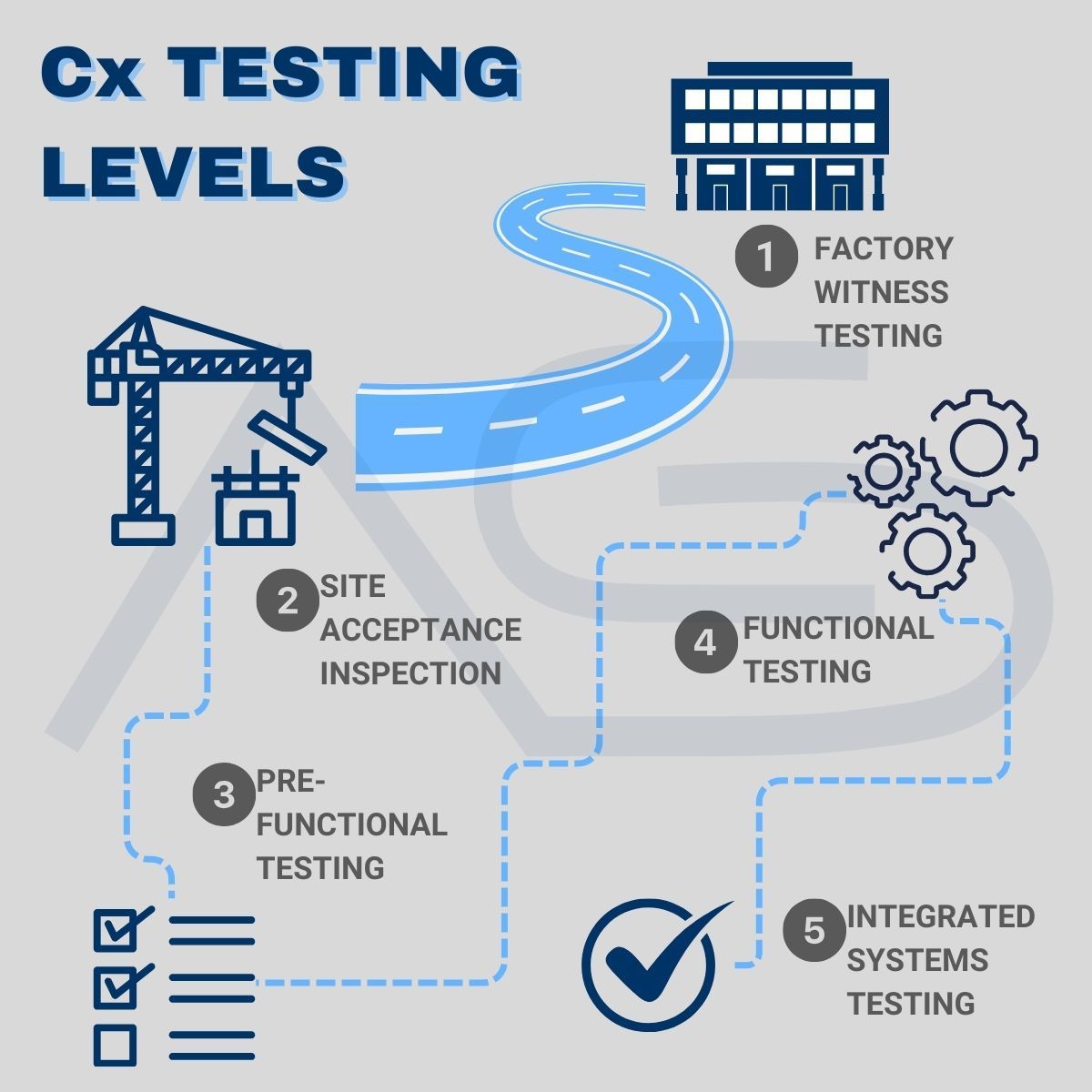
There are different types of “testing” in the commissioning stages. This is completed after the design phase, and is coordinated with the general contractor.
Level 1: Factory Witness Testing – At this initial stage, builders specify their expectations for equipment performance when purchasing the necessary components. The factory witness testing ensures that the equipment meets these expectations and adheres to industry standards.
Level 2: Site Acceptance Inspection – Once the equipment arrives on site, it undergoes inspection by the commissioning agent. This inspection serves to confirm that the equipment delivered matches the specifications outlined by the end user.
Level 3: Pre-Functional Testing (PFT) – Pre-functional testing involves a detailed examination of the equipment installation. Working in collaboration, the general contractor and commissioning agency assess whether the installation meets industry regulations and requirements. This phase also marks the first time the equipment is turned on and checked for functionality.
Level 4: Functional Performance Testing – This is the main thing commissioning is known for, but only part of what is actually in scope for the CxA. Functional performance testing goes beyond basic functionality checks and focuses on ensuring that the equipment operates as designed. This involves testing various operational scenarios and integrating fault systems to evaluate how the equipment responds under different conditions. The goal is to identify any potential performance issues, ensure proper integration of fault systems, and validate that the equipment meets the desired performance standards.
Level 5: Integrated Systems Testing (IST) – The final stage of commissioning, integrated systems testing, brings together all components and systems within the project. Through a series of tests, various systems are evaluated to ensure they function seamlessly together as designed. These tests encompass a wide range of scenarios to simulate real-world conditions and verify the reliability, resilience, and interoperability of the entire system.

Cx Testing Levels